And [mention, O Muhammad], when your Lord said to the angels, “Indeed, I will make upon the earth a successive authority.” They said, “Will You place upon it one who causes corruption therein and sheds blood, while we declare Your praise and sanctify You?” Allah said, “Indeed, I know that which you do not know.” (Al-Baqarah, 2:30)
We note in the verse above that the angels are wondering why God would chose a successive authority from among a people who cause corruption and bloodshed. Some scholars suggested that this means that the angels had already seen what mankind is capable of. But with Adam begins a new phase and a new experience.
And He taught Adam the names – all of them. Then He showed them to the angels and said, “Inform Me of the names of these, if you are truthful.” (Al-Baqarah, 2:31)
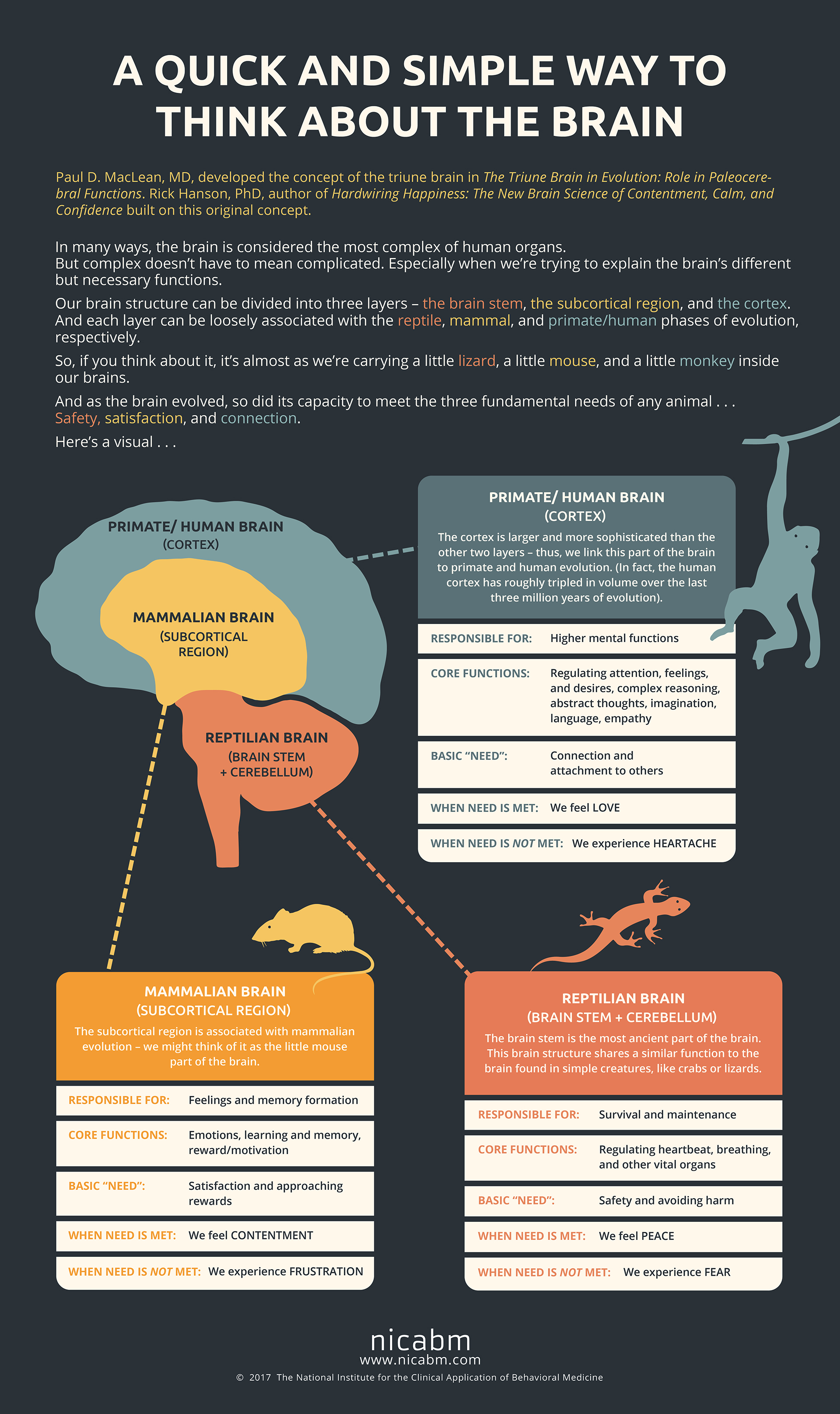
God teaches Adam the names of everything. This faculty of learning, naming and acquiring knowledge is perhaps in neuroscientific terms the activation of the cortex, the birth of consciousness. Man can now talk, communicate, and develop thought. (This process could also be considered from a lacanian perspective as the passage from the symbolic to the semiotic)
Going back to Freud’s topographical model, the conscious/unconscious world. We find that the unconscious is home to all repressed thought, difficult experiences, coping mechanisms, in essence, all the difficult experiences that we need to learn from and that form our defences.
Bringing things to consciousness means accessing this emotional world, making sense of it to control it. In one of his lectures, Bessel van der Kolk says, “there is no mind without mindfulness” because the emotional brain and the rational brain are not directly connected and the only way to access this part of the brain is the mid line structure of the brain which is responsible for self-perception. The Qur’an refers to al- naasiyah, which may be considered as the frontal lobe, again an amazing linguistic indication of the intricacy of expression in the Qur’an and the many layers of meanings hidden in every word.
“There is no capacity to own yourself without mindfulness and without knowing yourself…” Bessel Van der Kolk
“LANGUAGE IS AN EXTRAORDINARY THING, but we don’t often think about it as such. More or less everyone talks, they do it from an early age, in a spontaneous way and it all seems very easy and unremarkable. Yet, it is the single most obvious aspect of human behaviour that shows we are connected. The prime purpose of language is to communicate with others. It allows us to be consciously objective and allows us to express our deepest feelings. It is a mechanism by which we can consciously connect with the inner and also a mechanism by which we can span the distance between ourselves and others – we can project our mind by speaking our mind. “Stephen Pinker (2007b)
So how do Islamic teachings gear us for that capacity for consciousness and connection? (to be continued)
Below are some links that helped me formulate this post:
Bessel Van Der Kolk
https://www.youtube.com/watch?v=53RX2ESIqsM
Numan Ali-Khan
https://www.youtube.com/watch?v=5ckQ4RAWH8M&index=12&list=PLDJ4BO5iaAGP0sO-pvFEV57zy4hJW86_e
AbdulSaboor Shaheen
https://www.alkottob.com/book/2194/%D8%A3%D8%A8%D9%8A-%D8%A2%D8%AF%D9%85.html
 Psychoanalysis & Beyond
Leave a comment