11/2025
This project started 3 years ago. As a special interest reading group, we meet once a month, read a section of the Qur’an and a psychoanalytic paper, and discuss ideas that emerge from the readings
Qur’an: Surat an-Nisa verses 163 to 176
163- Indeed, We have revealed to you, [O Muḥammad], as We revealed to Noah and the prophets after him. And We revealed to Abraham, Ishmael, Isaac, Jacob, the Descendants,1 Jesus, Job, Jonah, Aaron, and Solomon; and to David We gave the book [of Psalms].
164- And [We sent] messengers about whom We have related [their stories] to you before and messengers about whom We have not related to you. And Allāh spoke to Moses with [direct] speech.
165- [We sent] messengers as bringers of good tidings and warners so that mankind will have no argument against Allāh after the messengers. And ever is Allāh Exalted in Might and Wise.
166- But Allāh bears witness to that which He has revealed to you. He has sent it down with His knowledge, and the angels bear witness [as well]. And sufficient is Allāh as Witness.
167- Indeed, those who disbelieve and avert [people] from the way of Allāh have certainly gone far astray.
168- Indeed, those who disbelieve and commit wrong [or injustice] – never will Allāh forgive them, nor will He guide them to a path,
169- Except the path of Hell; they will abide therein forever. And that, for Allāh, is [always] easy.
170- O mankind, the Messenger has come to you with the truth from your Lord, so believe; it is better for you. But if you disbelieve – then indeed, to Allāh belongs whatever is in the heavens and earth. And ever is Allāh Knowing and Wise.
171- O People of the Scripture, do not commit excess in your religion1 or say about Allāh except the truth. The Messiah, Jesus the son of Mary, was but a messenger of Allāh and His word which He directed to Mary and a soul [created at a command] from Him. So believe in Allāh and His messengers. And do not say, “Three”; desist – it is better for you. Indeed, Allāh is but one God. Exalted is He above having a son. To Him belongs whatever is in the heavens and whatever is on the earth. And sufficient is Allāh as Disposer of affairs.
172- Never would the Messiah disdain to be a servant of Allāh, nor would the angels near [to Him]. And whoever disdains His worship and is arrogant – He will gather them to Himself all together.
173- And as for those who believed and did righteous deeds, He will give them in full their rewards and grant them extra from His bounty. But as for those who disdained and were arrogant, He will punish them with a painful punishment, and they will not find for themselves besides Allāh any protector or helper.
174- O mankind, there has come to you a conclusive proof from your Lord, and We have sent down to you a clear light.
175- So those who believe in Allāh and hold fast to Him – He will admit them to mercy from Himself and bounty and guide them to Himself on a straight path.
176- They request from you a [legal] ruling. Say, “Allāh gives you a ruling concerning one having neither descendants nor ascendants [as heirs].” If a man dies, leaving no child but [only] a sister, she will have half of what he left. And he inherits from her if she [dies and] has no child. But if there are two sisters [or more], they will have two thirds of what he left. If there are both brothers and sisters, the male will have the share of two females.1 Allāh makes clear to you [His law], lest you go astray. And Allāh is Knowing of all things.
Paper: The Curative Factors of Psychoanalysis. Hannah Segal
Reaching the end of Surat an-Nisa provides an opportunity to reflect on the link between the surah’s beginning and its closing verses through the lens of Hannah Segal’s paper, The Curative Factors of Psychoanalysis. Segal highlights the curative process as involving:
1. The conscious experiencing and acknowledging of unconscious processes.
2. The movement of making the unconscious conscious.
3. The therapeutic value of accurate interpretations that lead to therapeutic insight.
The central question that emerges is: What are the curative factors being offered in this chapter, particularly in the closing verses (163-176)?
1. The Experience of Faith (Tawhid) as a Curative Factor
Surat an-Nisa begins with a call to all mankind to be mindful of God (Taqwa), emphasizing the fundamental values of justice and equality as the basis for societal organization:
“O mankind, be mindful of your Lord, who created you from a single soul, and from it created its mate, and from the pair of them spread countless men and women far and wide; be mindful of God, in whose name you make requests of one another. Beware of severing the ties of kinship: God is always watching over you.”
This foundational pillar is Tawheed (the Oneness and Unity of God). According to Ibn Qayyim al-Jawziyyah, tawheed is far higher than a mere verbal affirmation. It necessitates loving God, fearing Him, the submission of the heart and the limbs to Him, sincerely devoting all worship to Him, and directing all emotional life (love and hate) for His sake. Thus, Tawhid encompasses both the speech of the heart and the speech of the tongue.
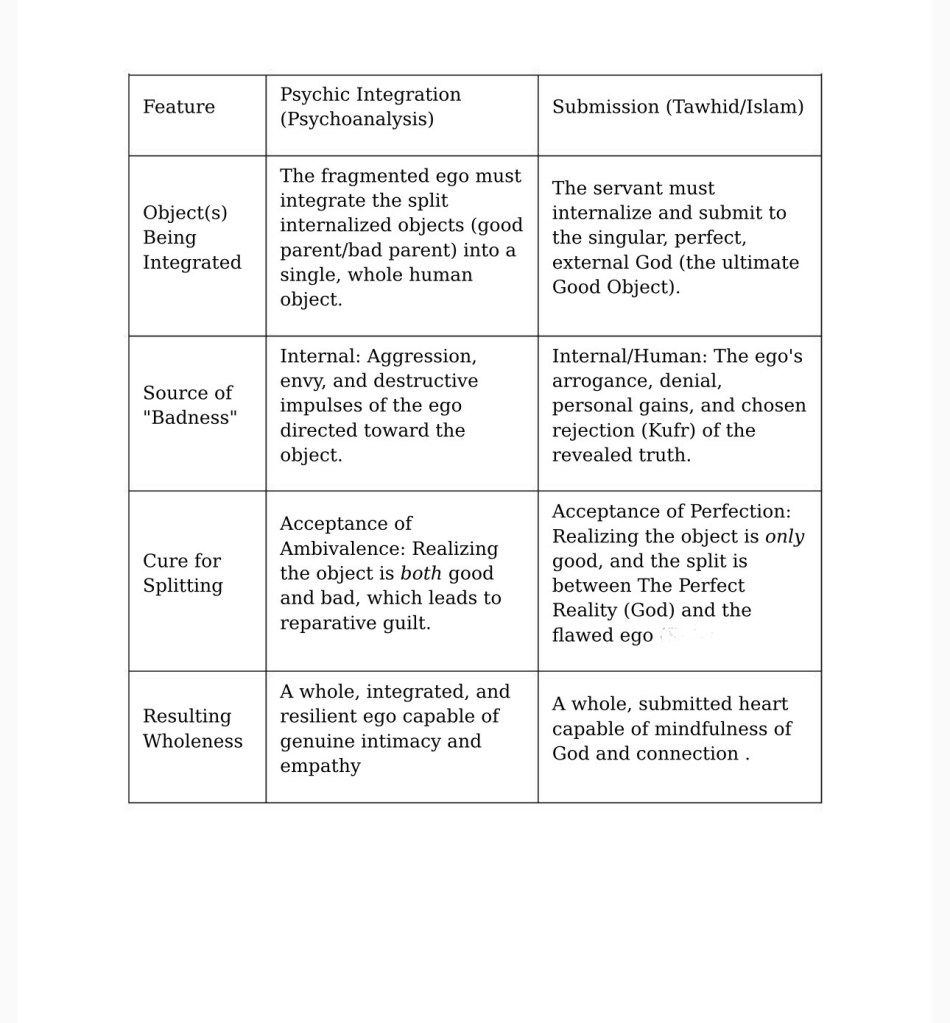
In psychoanalytic terms, the God-subject relationship is presented as a safe, consistent space to re-experience and resolve old relational patterns (Transference). The verses suggest that internalising God as The Perfect Object and ego as flawed is the beginning of the cure.
In other words, the first pillar of Islam, bearing witness to the oneness of God and the prophethood of Muhammad peace be upon him, is the ultimate curative factor aimed at remedying omnipotence and pathological narcissism through surrender and genuine connection. The verses at the end of the Surah (163-167) reinforce God’s loving, persistent efforts to establish this connection with humanity through a chain of prophets.
2. Kufr as a Defense Against Guilt and Connectedness
Verse 166 talks about the refusal to believe, which is presented as a conscious choice after receiving proof. This choice leads to Kufr. While often translated as disbelief, the Arabic root means to cover or seal. Its religious meaning is the act of concealing the truth of God from one’s heart, which is an act of ungratefulness.
The core reason kufr is problematic, just like pathological narcissism, is that it operates as a psychological organization in the mind that defends against both guilt and connectedness. It is not an entirely unconscious practice here because those who commit kufr after being sent proof have done so for personal gains, a clear motivation for maintaining a grandiose, false self. The example of Prophet Jesus (Isa, peace be upon him) is mentioned in this context (4:171-173), as his message was rejected or altered by those seeking to maintain their temporal status or theological excess.
3- The Prophet and the Law as the Therapeutic Frame
The role of the Messenger (Prophet Muḥammad) and the subsequent revelation is to establish the necessary therapeutic frame. In verse 163, God affirms the continuity of revelation, emphasizing that all prophets carried the same core message, providing a trustworthy, stable, and benevolent connection for people to orient their lives. The Messenger is a bearer of glad tidings and a Warner (4:165), setting clear boundaries and consequences.
This represents the second dimension of the therapeutic factors: the vertical relationship with God must be expressed in the horizontal relationship with people through ethical action and social law. The call to “believe, it is better for you” (4:170) and to “hold fast to Allah” (4:175) is the desired new functioning, a behavioral shift that is the fruit of insight and emotional confrontation. This acceptance of the message is the integration of ultimate reality (the Truth) into one’s character leading to a life free of the destructive conflicts caused by denial and misguidance.
Finally, the Surah concludes with the detailed inheritance rule (4:176). This serves as a powerful reminder that the curative process is not merely mystical or emotional; it requires practical action and the submission of one’s affairs and selfsh desires (e.g., in wealth distribution) to the Divine Law. This signifies the complete integration of the good object (Tawhid) into the ego structure, resulting in righteous conduct and a well-ordered society.
 Psychoanalysis & Beyond
Leave a comment