• Islam and Mental Health (7) A bit of Symbolism

    June 10, 2017
    Uncategorized

    This post was inspired by a book I read a month ago entitled The Second Half of Life: Opening the Eight Gates of Wisdom, by Angeles Arrien.

    In one section of the book, she speaks of 5 univeral shapes that appear in all art around the world and which are: the square, the circle, the triangle, the plus sign or equidistant cross and the spiral.

    Before I proceed here is a little game we can play: draw these shapes on a piece of paper then number them from 1 to 5 according to preference, 1 being the most favourite, 5 the least favourite, (and don’t give it too much thought).

    Now stop reading and do it then come back to the post.

    The fascinating thing is the way these preferences are explained. In all the fairytales of the world when there is a riddle to solve, the answer is never the first or the last answer, it is the middle one, so where you really are is your number 3. And here are the symbolic meanings of every shape:

    The triangle is the symbol of vision and wisdom

    The circle is the symbol of wholness, individuation, coming to one’s essence. It is also the need for space

    The square is the symbol of stability, solidity, security

    The plus sign is the symbol of coming together, the need for interaction

    The spiral is the need for growth, diversity and change.

    To find out how these different positions impact on eachother I am inclosing a link that explains everything at the end of the post.

    For me when I read this my mind drifted to the Ka’ba, and what its cubic shape symbolises: The square. According to Angeles Arrien, those attracted to the square are ready to build, to implement a plan and to manifest ideas. I thought that the square is then a symbol of practical concrete thinking, of the scientific approach that leads to action. But within the Ka’bah is the black stone, this mysterious entity that we greet and kiss because we were ordered to. I kept wondering what could this image be, and what came to my mind was that it was the essence of faith: that we have to believe in the signs of God, and these signs are concrete, everywhere around us, science leads us to them. However, and it is a big however, science has its limitations, it can only describe what is seen. But the minute we say that this amazing creature must have a creator, we have left the world of science to the realm of the intellect. The black stone is this unseen world, al-Gaib, which a solid base of knowledge can only point to.

    The movement we make around the ka’ba combines the circle and the spiral, both our individuation and our growth lie in the mastering of the two concepts the Ka’ba represents, acquiring knowledge while being mindful of God.

    I bow to the magnificence of God’s wisdom, that leaves such room for creativity and interpretation.

    I also wonder if these five shapes could be married with the five foundations of Islam but the task was a bit too much for my humble knowledge and abilities.

    So I leave you with these shapes and thoughts and the link to their interpretations.

    Click to access the_five_universal_shapes_handout.pdf


    4 comments on Islam and Mental Health (7) A bit of Symbolism
  • Islam and mental health (6) CPCAB seven processes of change. Building the relationship, an Islamic perspective

    June 7, 2017
    Uncategorized


    In my previous blog post, I mentioned Maslow’s Pyramid of needs and the missing apex that he added a few decades after the first formulation of this pyramid, the last apex being self-transcendence.

    And what is meant by self-transcendence after meeting the basic needs is the need  to see ourselves as part of the broader universe to develop the common priorities that can allow humankind to survive as a species.” (Nichol Bradford)

    Islam takes a reverse position in the sense that its teachings immediately put us in that state of self-transcendence, and tells us that we are connected in a common purpose which is to make it a better existence for everyone. There is a hadith that says that Islam was built on five, and we refer to these as the five pillars of Islam, perhaps a more accurate translation would be the five foundations of Islam. These five foundations are what keeps the inner structure of the Muslim safe and sound because they directly impact our mental health, and they are:

    • Shahadah, (declaration of faith)
    • Prayer
    • Zakah (Prescribed alms)
    • Fast
    • Pilgrimage


    I would like to think about them now from a relational perspective and how each impacts our psyche.

    The first one, shahadah[1], is self-transcendence to connect to the One. As a Muslim I am immediately invited to bare witness that there is no God but Allah, and that Muhammad is his messenger, a statement that immediately empowers me as an individual, in the very fact that it makes me a witness. But as witnesses of His way, we need a strong bond, a strong connection, like in any organizational environment, only we have direct access to Him. How? Through prayer. So why is prayer so important for psychic health?

    Lately, the latest craze is practicing meditation, to achieve peace of mind, clarity, equanimity etc. Neuroscience has now provided us with proof of its impact on our health:  a boosted immune system, lower blood pressure, and assistance in combating psoriasis as well as other conditions.

    The Islamic perspective is not just to be mindful but to be mindful of God. Mindfulness of God or as we call it in Arabic Taqwa Allah, is what elevates us in ranks, what builds our inner strength because we are connected to an inexhaustible source, with His 99 attributes of beauty and might. Knowing that God is present in us, with us, for us, at all times, is the ultimate source of strength and appeasement. Islamic teachings stress the importance of Prayer to the point that if you cannot stand up to do it, you are allowed to perform it sitting down, if you cannot perform it sitting down, then you are allowed to perform it lying down, if you cannot, then you can perform it with mere eye movement, because everyone needs to feel connected to the divine source, to build healthier synapses and stronger connections.

    We are also taught to self-transcend in the performance of Zakāh, which is (prescribed) alms[2]

    It creates awareness of the need of others and their right over us to provide for them. It gives them the right to a dignified living, taking away the shame of receiving charity by making it a prescribed right while giving us the benefit of giving and gaining the benefit of serving others. Ultimately it creates a caring society.

    Even in the teaching of fasting, God says that He alone rewards for it and that it is a way to give thanks to Him. In fact, everything we are encouraged to do to please Him, has a psychological benefit for us. Prayers build resilience and resilience builds ability to overcome trauma. Fasting builds the ability to withstand delayed gratification (there is research in mental health that people who can accept delayed gratification are more successful and resilient  in later life because it builds self-discipline) it has health benefits, but ultimately for us it teaches us how to be mindful of God.

    And finally pilgrimage which instils the sense of equality and humility is the reality check we need to remind us that we don’t leave this life with much, just a shroud and that what matters is the relationship we built with God and his creatures and not with things.

    The biggest mistake we make as Muslims, when we practice these foundations of our faith, is to think that we do them as an obligation to avoid God’s wrath or gain His reward. We forget that nothing we do or don’t do adds or takes away anything from His kingdom. And we do that when we lose insight and mindfulness of the purpose of worship.

    The gift God is giving us is really tying our happiness and our sound mental health to the idea that we are giving Him something when in fact we are doing ourselves the service.

    Self- transcendence is the essence of the human experience because there is no me without you and there is no man without God.

    Finally I would like you to bear in mind that the objective of this article is not to state the benefits of the 5 pillars of Islam because one could probably write books on the subject, but merely to point out that God has put a system that helps build a strong mind and a sound relational system because He made us social beings. I do not mean to say that Muslims are not affected by mental illness because they are, I just wanted to highlight that the 7 processes to effect change stated by the CPCAB are part and parcel of the foundations of our faith, which in itself suggests the healing value of every practice prescribed on us.

    Finally, this leaves me with a thought to ponder, what does it mean to have this as the foundation of the pyramid of needs and not as its apex and how does the different position impact a person’s psyche?


    Here one interesting link On delayed gratification:

    The marshmallow experiment

    https://www.youtube.com/watch?v=lWURnHkYuxM

    Footnotes:

    [1] declaration of faith

    “I bear witness that there is no god but Allāh*, and that Muḥammad is His Messenger.” Allāh is the Arabic name for the One and Only God, the same God shared by all monotheistic faiths (the name Allāh is often used by Arabic-speaking Christians and Jews). The name Allāh encompasses all the divine names and attributes of the Lord of the worlds, and hence the vast scopes of meaning it has. It is for this reason that Muslims consider it unique. Unlike the word ‘God’, the word ‘Allāh’ in Arabic has no inflections of gender or number.


    http://www.adageonline.org/Glossary/search/%D8%B4%D9%87%D8%A7%D8%AF%D8%A9

    [2] One of the five pillars of Islām It is a calculated proportion of a Muslim’s wealth that is paid annually for the benefit of the needy. It is due on certain assets, once their value reaches a certain threshold and the calculation varies according to the nature of the asset.

    http://www.adageonline.org/Glossary/search/Alms


    4 comments on Islam and mental health (6) CPCAB seven processes of change. Building the relationship, an Islamic perspective
  • Islam and Mental Health (5) CPCAB processes of change. Safety, Shariaa and Maslow’s pyramid of needs

    June 3, 2017
    Uncategorized

    Still on the first point of the seven processes. In thinking about the frame and Shariaa, I could not ignore Abrahm Maslow’s Pyramid of needs.

    Founder of the humanistic school, Abraham Maslow was first to take into account the impact of external factors on the person’s psyche, contrary to Freud’s take which focused primarily on the internal world of the individual.

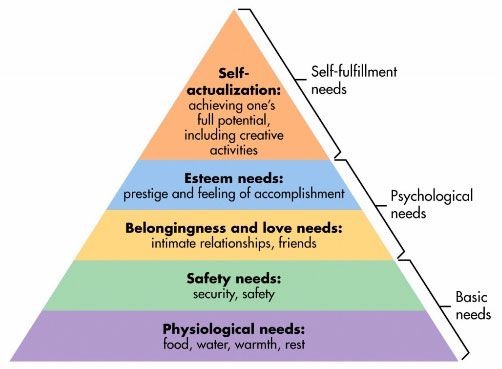
    At the base of the pyramid are physiological needs, followed by safety needs then love and belonging needs, esteem needs, and finally at the top self-actualization needs. The image below explains what each level entails.

    maslow-pyramid

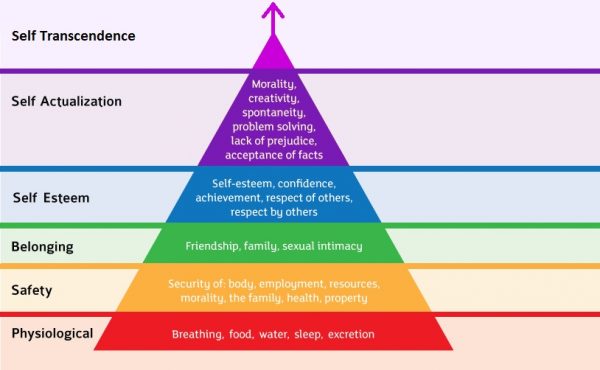
    However, I stumbled upon a very interesting article recently that states that in 1970, Maslow added a final apex after self-actualization which is self-transcendence:

    “Having met our basic needs at the bottom of the pyramid, having worked on our emotional needs in its middle and worked at achieving our potential, Maslow felt we needed to transcend thoughts of ourselves as islands. We had to see ourselves as part of the broader universe to develop the common priorities that can allow humankind to survive as a species.” (Nichol Bradford)

    Maslows--Self-Transcendence-600x370


    This final apex figuring at the top of the pyramid of needs as a final achievement is quiet mind boggling. The suggestion is that only when all the other needs are met can we reach that level. But all my life, Islam has taught me otherwise.  In my view, from an Islamic perspective shariaa teaches us that connection, transcendence and thinking about others is at the base of our pyramid of need. That’s why we are provided from the start with a toolkit that guaranties the building of this capacity to transcend our personal needs and build the relationship, which leads me to the next point in the seven processes to effect change, which is building the relationship.

    (to be continued :))

    Below is the link to the article mentioned in this post.

    http://bigthink.com/robby-berman/the-missing-apex-of-maslows-hierarchy-could-save-us-all

    2 comments on Islam and Mental Health (5) CPCAB processes of change. Safety, Shariaa and Maslow’s pyramid of needs
  • Islam and mental health (4) CPCAB’s seven processes that lead to change. An Islamic perspective

    June 1, 2017
    Uncategorized

    Islam and mental health (4)


    Are you familiar with sea squirts? Sea squirts are maritime creatures that once they choose where to settle, eat their own brain. I found this fact fascinating. Having a brain is about movement. Movement in human terms is about progressing in life, “if you are not progressing you are regressing”, you are not standing still, because standing still means you are losing acquired knowledge and skills due to lack of practice. Otherwise, we are leading the life of a sea squirt, which I presume is feeding and reproducing.

    And when we are at a stand-still, experiencing stuckness, getting depressed about it mental health issue may arise because the sense of purpose carried in our essence of being, in our possession of a thinking mind, is being blocked.

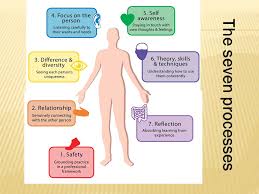
    In counselling, the CPCAB model suggests seven helping and counselling processes that support client change to create this necessary movement:

    • Working ethically and professionally
    • Working with the relationship
    • Working with difference and diversity
    • Working with primary focus on the client
    • Working with self-awareness
    • Working with a coherent framework of skills and theory
    • Working reflectively

    sevenprocesses

    As the drawing shows. Every one of these processes enhances a quality in the building of change. The first of which is working according to a professional, ethical framework to generate the feeling of safety.  And safety is reinforced by keeping boundaries. And I would like to unpick these seven processes from an Islamic perspective, starting with the meaning of boundaries.

    Islam reflects the importance of the frame work, what we call in islam Shariaa and which literally means the way. Shariaa nowadays, is a word that has been used and abused to propagate fear about Islam, when in fact it was introduced to create this very opposite feeling of safety we need to start a fruitful relationship. It is nothing but a tool to guide us to the safe passage through life. To put it in context, the number of verses in the Qur’an is 6236 and the number of verses related to Islamic jurisprudence is 500 verses. So one should not reduce Islam to Shariaa, nor attribute to Shariaa what it is not.

    To understand Shariaa people need to understand that its objectives are focused on protecting the Islamic conception of life and death, from which we deduce:

    – Promoting and protecting human dignity

    – Welfare

    – Knowledge

    – Creativity

    – Autonomy

    – Development

    – Equality

    – Freedom

    – Justice

    – Fraternity

    – Love

    – Solidarity

    – Diversity

    To read more on the subject I would strongly recommend Tariq Ramadan’s book, Radical Reform.

    But back to Mental health, as I said previously, when learning about mental health, I came to realize the extent to which Islam is invested in the creation and protection of a sound mind and body, starting with establishing a safe holding environment that allows the individual and society to prosper. And this is the purpose of Shariaa, to create a safe holding environment.

    (To be continued :))

    3 comments on Islam and mental health (4) CPCAB’s seven processes that lead to change. An Islamic perspective
  • Islam and Mental Health (3) The story of Adam (PBUH) and the birth of consciousness- A neuroscientific perspective.

    May 29, 2017
    Uncategorized

    And [mention, O Muhammad], when your Lord said to the angels, “Indeed, I will make upon the earth a successive authority.” They said, “Will You place upon it one who causes corruption therein and sheds blood, while we declare Your praise and sanctify You?” Allah said, “Indeed, I know that which you do not know.” (Al-Baqarah, 2:30)

    We note in the verse above that the angels are wondering why God would chose a successive authority from among a people who cause corruption and bloodshed. Some scholars suggested that this means that the angels had already seen what mankind is capable of. But with Adam begins a new phase and a new experience.

    And He taught Adam the names – all of them. Then He showed them to the angels and said, “Inform Me of the names of these, if you are truthful.” (Al-Baqarah, 2:31)

    God teaches Adam the names of everything. This faculty of learning, naming and acquiring knowledge is perhaps in neuroscientific terms the activation of the cortex, the birth of consciousness. Man can now talk, communicate, and develop thought. (This process could also be considered from a lacanian perspective as the passage from the symbolic to the semiotic)

    Going back to Freud’s topographical model, the conscious/unconscious world. We find that the unconscious is home to all repressed thought, difficult experiences, coping mechanisms, in essence, all the difficult experiences that we need to learn from and that form our defences.

    Bringing things to consciousness means accessing this emotional world, making sense of it to control it. In one of his lectures, Bessel van der Kolk says, “there is no mind without mindfulness” because the emotional brain and the rational brain are not directly connected and the only way to access this part of the brain is the mid line structure of the brain which is responsible for self-perception. The Qur’an refers to al- naasiyah, which may be considered as the frontal lobe, again an amazing linguistic indication of the intricacy of expression in the Qur’an and the many layers of meanings hidden in every word.

    “There is no capacity to own yourself without mindfulness and without knowing yourself…” Bessel Van der Kolk

    “LANGUAGE IS AN EXTRAORDINARY THING, but we don’t often think about it as such. More or less everyone talks, they do it from an early age, in a spontaneous way and it all seems very easy and unremarkable. Yet, it is the single most obvious aspect of human behaviour that shows we are connected. The prime purpose of language is to communicate with others. It allows us to be consciously objective and allows us to express our deepest feelings. It is a mechanism by which we can consciously connect with the inner and also a mechanism by which we can span the distance between ourselves and others – we can project our mind by speaking our mind. “Stephen Pinker (2007b)

    So how do Islamic teachings gear us for that capacity for consciousness and connection? (to be continued)

    Below are some links that helped me formulate  this post:

    Bessel Van Der Kolk

    https://www.youtube.com/watch?v=53RX2ESIqsM

    Numan Ali-Khan

    https://www.youtube.com/watch?v=5ckQ4RAWH8M&index=12&list=PLDJ4BO5iaAGP0sO-pvFEV57zy4hJW86_e

    AbdulSaboor Shaheen

    https://www.alkottob.com/book/2194/%D8%A3%D8%A8%D9%8A-%D8%A2%D8%AF%D9%85.html

    Web

    No comments on Islam and Mental Health (3) The story of Adam (PBUH) and the birth of consciousness- A neuroscientific perspective.
  • Islam and Mental health (2) The story of Adam (PBUH) and the theory of object relation

    May 28, 2017
    Uncategorized

    When Freud the father of psychoanalysis tried to unpick the human psyche he suggested that people are motivated by drives that need to be satisfied. Mainly the death drive (Thanatos) represents all the drives that lead to self-destruction and the survival drive (Eros) is responsible for the life-producing drives. Melanie Klein took the theory further in maintaining that the true motivation is building relationships with others and the primary relationship with mother is the template on which a person’s life is going to be built. If we internalize mother as a good object, then we will always draw from the goodness of this experience in difficult times.

    When looking at the story of Adam and Eve from this perspective, we realize that their short experience in heaven was necessary for them to carry the mission that God had entrusted them with.

    And [mention, O Muhammad], when your Lord said to the angels, “Indeed, I will make upon the earth a successive authority.” (Al-Baqarah, 2:30)

    There is a great symbolic meaning to the experience of Adam and Eve, away from the idea of a persecutory original sin that does not exist in the Islamic narrative.  It was a necessary experience to internalize God as the good object before facing life on earth. They needed to reach that maturational state and experience the death instinct and conflicting drives to be able to understand love, guilt and reparation. Once the healing dyad is formed a person is ready to face life.

    There are great parallels here between this experience and the experience of motherhood and how a mother builds her child’s internal world; it may be why Islam reveres motherhood and parenthood in general and gives it this high position.

    4 comments on Islam and Mental health (2) The story of Adam (PBUH) and the theory of object relation
  • Islam and Mental health (1) Secret Kindness

    May 28, 2017
    Uncategorized

    Ever since I started studying counselling and psychotherapy, I have been amazed at the care, in Islam, put into building a sound mind and good mental health. 

    I would like to share with you through the blog, some of the things I came across that triggered these feelings. One of them is this Ayah in Surat al-Baqara regarding charity.
     

    If you disclose your charitable expenditures, they are good; but if you conceal them and give them to the poor, it is better for you, and He will remove from you some of your misdeeds [thereby]. And Allah, with what you do, is [fully] Acquainted. (2:271)

    Many of us would have read this ayah over and over again, but did you ever wonder why it is good for us to give charity in secret, while giving charity openly is just good?

    I found out the reason why or perhaps one of the reasons why from a psychological point of view in a video on ways to overcome depression. And one of the things that people are suffering with depression are advised to do is to do charitable acts, but not just that. What they are specifically asked to do is to do secret acts of kindness. Because secret kindness builds the person’s sense of self esteem, away from people’s judgement and applause, but the video explains it better.

    http://www.nicabm.com/a-secret-kindness-intervention-for-working-with-depression/


     Islam and mental health

    Ramadan reflections (1)

    Ever since I started studying counselling and psychotherapy, I have been amazed at the care put into building a sound mind and good mental health. My faith only keeps getting reinforced and I am just in awe of the magnificence of Islam.

    I would like to share with you throughout the month, some of the things I came across that triggered these feelings. One of them is this Ayah in Surat al-Baqara regarding charity.


    If you disclose your charitable expenditures, they are good; but if you conceal them and give them to the poor, it is better for you, and He will remove from you some of your misdeeds [thereby]. And Allah, with what you do, is [fully] Acquainted. (2:271)

    Many of us would have read this ayah over and over again, but did you ever wonder why it is good for us to give charity in secret, while giving charity openly is just good?

    I found out the reason why or perhaps one of the reasons why from a psychological point of view in a video on ways to overcome depression. And one of the things hat people are suffering with depression are advised to do is to do charitable acts, but not just that. What they are specifically asked to do is to do secret acts of kindness. Because secret kindness builds the person’s sense of self esteem, away from people’s judgement and applause, but the video explains it better.

    http://www.nicabm.com/a-secret-kindness-intervention-for-working-with-depression/

    1 comment on Islam and Mental health (1) Secret Kindness
Previous Page
1 … 3 4 5

Blog at WordPress.com.

Psychoanalysis & Beyond

A Psychoanalytic lens on Islamic text

  • Home
  • About
  • Contact
  • Blog
 

Loading Comments...
 

    • Subscribe Subscribed
      • Psychoanalysis & Beyond
      • Already have a WordPress.com account? Log in now.
      • Psychoanalysis & Beyond
      • Subscribe Subscribed
      • Sign up
      • Log in
      • Report this content
      • View site in Reader
      • Manage subscriptions
      • Collapse this bar