The reading
Al-Ma’edah: verses 51 to 66
51- O you who have believed, do not take the Jews and the Christians as allies. They are [in fact] allies of one another. And whoever is an ally to them among you – then indeed, he is [one] of them. Indeed, Allah guides not the wrongdoing people.
52- So you see those in whose hearts is disease hastening into [association with] them, saying, “We are afraid a misfortune may strike us.” But perhaps Allah will bring conquest or a decision from Him, and they will become, over what they have been concealing within themselves, regretful.
53- And those who believe will say, “Are these the ones who swore by Allah their strongest oaths that indeed they were with you?” Their deeds have become worthless, and they have become losers.
54- O you who have believed, whoever of you should revert from his religion – Allah will bring forth [in place of them] a people He will love and who will love Him [who are] humble toward the believers, powerful against the disbelievers; they strive in the cause of Allah and do not fear the blame of a critic. That is the favour of Allah ; He bestows it upon whom He wills. And Allah is all-Encompassing and Knowing.
55- Your ally is none but Allah and [therefore] His Messenger and those who have believed – those who establish prayer and give zakah, and they bow [in worship].
56- And whoever is an ally of Allah and His Messenger and those who have believed – indeed, the party of Allah – they will be the predominant.
57- O you who have believed, take not those who have taken your religion in ridicule and amusement among the ones who were given the Scripture before you nor the disbelievers as allies. And fear Allah , if you should [truly] be believers.
58- And when you call to prayer, they take it in ridicule and amusement. That is because they are a people who do not use reason.
59- Say, “O People of the Scripture, do you resent us except [for the fact] that we have believed in Allah and what was revealed to us and what was revealed before and because most of you are defiantly disobedient?”
60- Say, “Shall I inform you of [what is] worse than that as penalty from Allah ? [It is that of] those whom Allah has cursed and with whom He became angry and made of them apes and pigs and slaves of Taghut. Those are worse in position and further astray from the sound way.”
61- And when they come to you, they say, “We believe.” But they have entered with disbelief [in their hearts], and they have certainly left with it. And Allah is most knowing of what they were concealing.
62- And you see many of them hastening into sin and aggression and the devouring of [what is] unlawful. How wretched is what they have been doing.
63- Why do the rabbis and religious scholars not forbid them from saying what is sinful and devouring what is unlawful? How wretched is what they have been practicing.
64- And the Jews say, “The hand of Allah is chained.” Chained are their hands, and cursed are they for what they say. Rather, both His hands are extended; He spends however He wills. And that which has been revealed to you from your Lord will surely increase many of them in transgression and disbelief. And We have cast among them animosity and hatred until the Day of Resurrection. Every time they kindled the fire of war [against you], Allah extinguished it. And they strive throughout the land [causing] corruption, and Allah does not like corrupters.
65- And if only the People of the Scripture had believed and feared Allah , We would have removed from them their misdeeds and admitted them to Gardens of Pleasure.
66- And if only they upheld [the law of] the Torah, the Gospel, and what has been revealed to them from their Lord, they would have consumed [provision] from above them and from beneath their feet. Among them are a moderate community, but many of them – evil is that which they do.
Paper: The dread of sameness: social hatred and
Freud’s “narcissism of minor differences”
Karl Figlio
https://www1.essex.ac.uk/cps/documents/Dread-of-sameness.pdf
The discussion:
Bringing together the two readings and extracting an understanding of sameness and difference was a challenging undertaking. It required a return to basics and a reviewing of the starting points of what I was trying to do on the one hand. On the other, I wanted to be concise and to the point, which meant choosing a focus and leaving out many interesting observations for the sake of clarity.
Karl Figlio suggests that the greatest psychic anxiety is not difference, but the collapse of distinction. If there is no difference between self and other, the individual faces “psychic death” or a return to a primitive, undifferentiated state.
Surat al Ma’idah, as we have been seeing over the past readings signals a movement from an address to mankind to a call to the believers. So how do we understand this act in terms of the psychoanalytic paper. It is the surah that addresses a specific kind of Muslims; “O You who believe”. The believer here is not merely a descriptive term but an assignment of authority. This is in reference to Stokoe’s concept of authoritative authority, which enables delegated decision making, accountability and communication, a recognition of the primary task and curiosity. In this context Iman (belief) is an assignment of authority. It creates a primary task for the believer: to maintain a heart-space oriented toward Tawheed (oneness of God). While Islam is an outward submission, iman (belief) is the inward conviction and the reality of the heart.
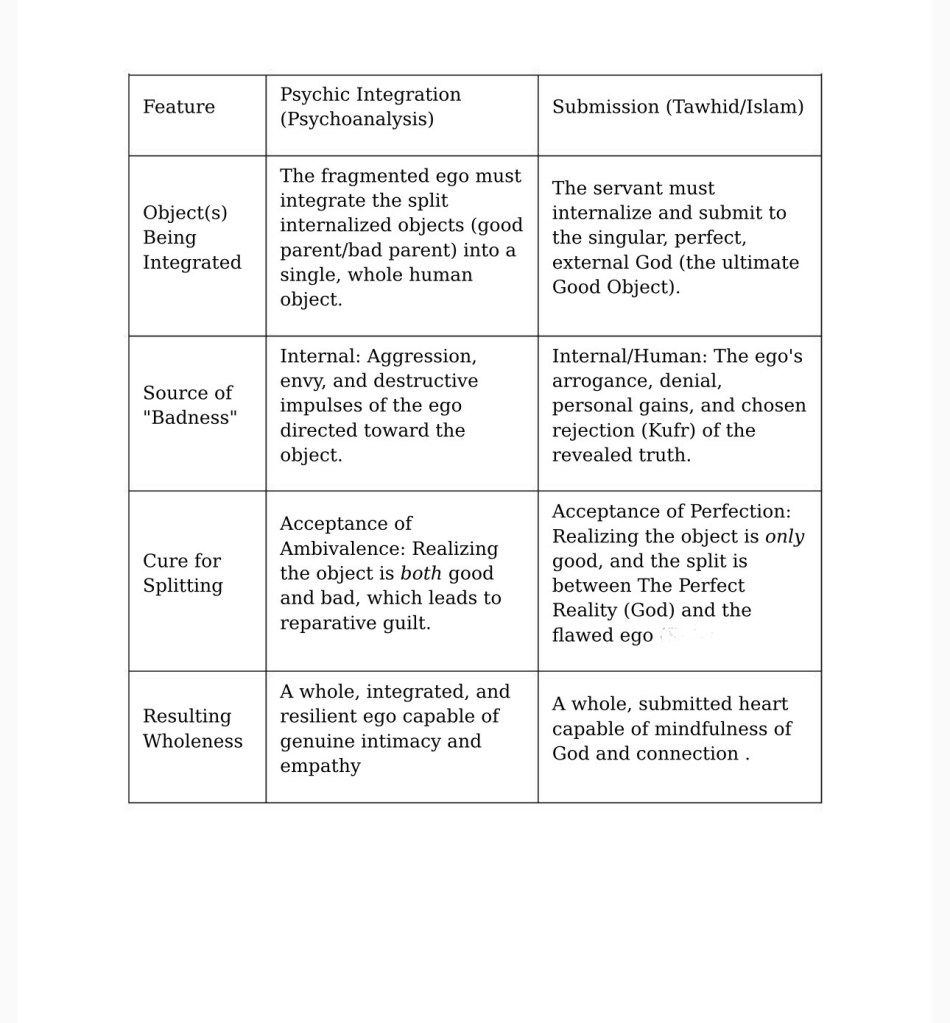
So how does a system based on the ontological truth of Tawheed fit with a system based on the fundamental premise that human behaviour is based on unconscious beliefs?
While psychology says we emphasize differences to feel unique, the Quran says we maintain these boundaries to stay true to our purpose. Without that boundary, our spiritual identity doesn’t just change it evaporates.
To this effect, Verses 51 to 54 introduce a very important concept in Islam which is walaa’ and baraa’ (allegiance and disavowal).
Walaa’ (allegiance) according to Ibn Achour is a deep-seated alliance that influences the order of the community and offers a protective boundary that prevents the dilution of Islamic law and societal identity. Baraa’ (disavowal or dissociation) according to ibn Achour is a defensive necessity that refers to psychological and social distancing from actions or groups that actively seek to spoil or undermine the foundational good of the faith. Ibn Achour sees this as the immune system of the ummah.
It is important here to distinguish between Figlio’s narcissism which is a horizontal movement of differentiation to feel superior and Bara’ which is a vertical movement of differentiation in order to remain faithful to the divine. It is not a call for social hatred. Moreover, Islam states the rule based on which God differentiates or elevates people over people:
Verse 13 of Surat Al Hujurat,
O mankind, indeed We have created you from male and female and made you peoples and tribes that you may know one another. Indeed, the most noble of you in the sight of Allah is the most righteous of you. Indeed, Allah is Knowing and Acquainted.
This verse highlights difference as a governing necessity in horizontal relations to generate interest and curiosity, and righteousness as a fundamental requirement and value system to fulfil the vertical relationship with God.
While Al-Hujurat establishes difference as a healthy necessity for curiosity, the ‘disease of the heart’ in Al-Ma’idah suggests a breakdown of this capacity. In psychoanalytic terms it is a move to the paranoid schizoid position. If we thought of disbelief and hypocrisy in those terms, the fear of defining their identity and incurring the rath of another group leads to the denial of the truth. Figlio suggests we use differences to avoid sameness; however the hypocrite does the opposite; he seek false sameness to hide. This attempt to “de-differentiate” oneself to avoid being a target is a defence against the anxiety of standing alone in one’s authoritative authority.
The verses show the dynamics of spiritual failure and how this denial of truth then turns into envy (verses 59 and 64) towards those who hold on to it and a wish to destroy the goodness the other has.
Verse 60 describes a regression to animalistic forms thus mapping the psychic death that occurs when the vertical distinction of Tawheed collapses, leaving only a primitive, instinctual existence. Similarly, the accusation in verse 64 that “God’s hand is chained” operates as projective identification where the group’s internal spiritual constriction and envy are projected onto the Divine.
If the heart loses its distinction (Bara’) from falsehood, it suffers from heedlessness. This is the spiritual equivalent of Figlio’s primitive state. A heart that cannot distinguish between Truth and Falsehood has effectively collapsed into a state of spiritual infancy. This infancy means they cannot perform the task of Tawheed, bearing witness that there is no God but God.
Therefore, the verses have three distinct movements. The beginning talks about a split position due to anxiety. Then there is a capacity for integration in verses 54 to 56, then verses 57 to 66 illustrate a regression into envy where the inability to internalise the good leads to a wish to spoil it. Is it possible that this envy of the new Muslim community is because it reflects the other’s lost connection to the truth? A persecutory sameness? The resentment here is about the recovery of a truth they once held. The sameness of the faith is what feels annihilating to their distinct sociopolitical status. Thus, deviation is a tragic flight from a shared Divine reality.
While the Qur’an asserts its truth, it also states that the ultimate verdict on other faiths is in the hereafter. Religious pluralism and the test of diversity are necessary catalysts for striving and competing to do better, for generating interest and curiosity.
Based on the reading we can see that difference located in the depressive position is a propeller for the good, which in Figlio’s terms allows for stable difference, while in the paranoid schizoid position it becomes a tool to divide and conquer, tiny distinctions are weaponized to create a false sense of superiority. Creating that heart space where there is room to hold the tension between the two position, staying connected to the source and not collapsing into doer and done to relationships may be the psychological task of the believer.



 Psychoanalysis & Beyond