Islam and mental health (4)
Are you familiar with sea squirts? Sea squirts are maritime creatures that once they choose where to settle, eat their own brain. I found this fact fascinating. Having a brain is about movement. Movement in human terms is about progressing in life, “if you are not progressing you are regressing”, you are not standing still, because standing still means you are losing acquired knowledge and skills due to lack of practice. Otherwise, we are leading the life of a sea squirt, which I presume is feeding and reproducing.
And when we are at a stand-still, experiencing stuckness, getting depressed about it mental health issue may arise because the sense of purpose carried in our essence of being, in our possession of a thinking mind, is being blocked.
In counselling, the CPCAB model suggests seven helping and counselling processes that support client change to create this necessary movement:
- Working ethically and professionally
- Working with the relationship
- Working with difference and diversity
- Working with primary focus on the client
- Working with self-awareness
- Working with a coherent framework of skills and theory
- Working reflectively
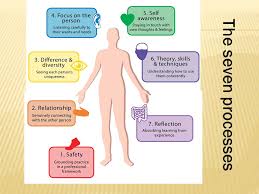
As the drawing shows. Every one of these processes enhances a quality in the building of change. The first of which is working according to a professional, ethical framework to generate the feeling of safety. And safety is reinforced by keeping boundaries. And I would like to unpick these seven processes from an Islamic perspective, starting with the meaning of boundaries.
Islam reflects the importance of the frame work, what we call in islam Shariaa and which literally means the way. Shariaa nowadays, is a word that has been used and abused to propagate fear about Islam, when in fact it was introduced to create this very opposite feeling of safety we need to start a fruitful relationship. It is nothing but a tool to guide us to the safe passage through life. To put it in context, the number of verses in the Qur’an is 6236 and the number of verses related to Islamic jurisprudence is 500 verses. So one should not reduce Islam to Shariaa, nor attribute to Shariaa what it is not.
To understand Shariaa people need to understand that its objectives are focused on protecting the Islamic conception of life and death, from which we deduce:
– Promoting and protecting human dignity
– Welfare
– Knowledge
– Creativity
– Autonomy
– Development
– Equality
– Freedom
– Justice
– Fraternity
– Love
– Solidarity
– Diversity
To read more on the subject I would strongly recommend Tariq Ramadan’s book, Radical Reform.
But back to Mental health, as I said previously, when learning about mental health, I came to realize the extent to which Islam is invested in the creation and protection of a sound mind and body, starting with establishing a safe holding environment that allows the individual and society to prosper. And this is the purpose of Shariaa, to create a safe holding environment.
(To be continued :))


 Psychoanalysis & Beyond
Leave a comment